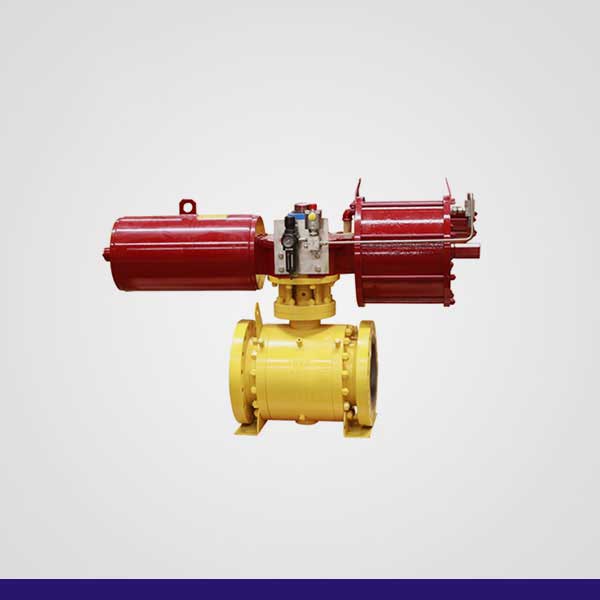

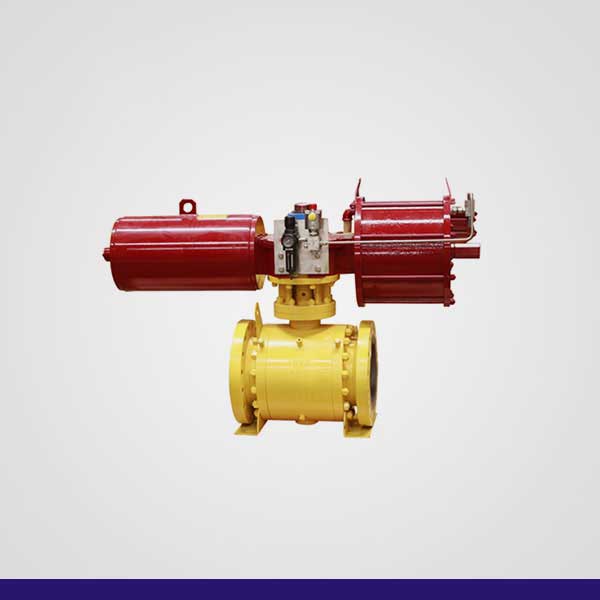
Three-piece Sealed Fixed Ball Valve Q347Y
Functional Application
Ball valves are widely used in piping systems for shut-off, diversion and flow direction switching of media. As a new type of valve that has gained extensive promotion in recent years, ball valves possess the following advantages:
1. Low fluid resistance, with drag coefficient equal to that of a pipe of equivalent length.
2. Simple structure, compact size and light weight.
3. Reliable sealing performance. Plastic materials are widely adopted for sealing surfaces, delivering excellent sealing capability, and are also widely applied in vacuum systems.
4. Easy operation and rapid switching. Only a 90° rotation is required to switch between fully open and fully closed status, suitable for remote control.
5. Convenient maintenance. Simple valve construction, with movable sealing rings for easy disassembly and replacement.
6. At fully open or fully closed position, the sealing surfaces of ball and seat are isolated from process media, preventing sealing surface erosion during medium flow.
7. Wide service range, with sizes ranging from several millimeters to several meters, and applicable from high vacuum to ultra-high pressure conditions.
Currently, ball valves are widely utilized in industries including petroleum, chemical engineering, power generation, papermaking, atomic energy, aerospace, rocket engineering and daily civilian fields.
Main Classification
By Structural Design
1. Floating Ball Valve
The ball body of floating ball valves is unconstrained. Under medium pressure, the ball body generates displacement and presses tightly against the outlet sealing surface to achieve reliable end sealing.
Floating ball valves feature simple construction and good sealing performance. However, the full medium load acting on the ball body is fully transferred to the outlet sealing ring. Therefore, the sealing material must be verified to withstand the working pressure load. This design is widely applied for low and medium pressure service.
2. Fixed (Trunnion) Ball Valve
The ball body of fixed ball valves is secured and will not displace under pressure. All trunnion mounted ball valves are equipped with floating seats. When subjected to medium pressure, the valve seat moves axially, pressing the sealing ring firmly against the ball body to achieve tight sealing.
Upper and lower support trunnion shafts are usually installed on the ball body, reducing operating torque, making this design ideal for high pressure and large diameter valves.
To reduce operating torque and improve sealing reliability, oil-sealed ball valves have been developed. Special lubricant is injected between sealing faces to form an oil film, which enhances sealing performance and lowers operation torque, making them more suitable for extra large bore high pressure ball valves.
3. Elastic Ball Valve
The ball body of an elastic ball valve is elastic. Both the ball body and valve seat sealing ring are fabricated from metallic materials, resulting in a high specific sealing pressure. Reliable sealing cannot be achieved by the medium pressure alone, so external compressive force must be applied.
This type of valve is applicable for high temperature and high pressure working conditions.
An elastic compliant groove is machined at the lower inner wall of the ball body to provide elasticity. When closing the flow passage, the wedge-shaped head of the valve stem pushes the ball body tightly against the valve seat to form a tight seal. When rotating the ball body to open the valve, the wedge head is first released, the ball body rebounds to its original geometry, creating a tiny clearance between the ball and valve seat. This effectively reduces sealing surface friction and required operating torque.
Classification by Port Configuration
According to channel layout, ball valves are categorized into straight pattern, three-way pattern and right-angle pattern. The latter two types are used to distribute medium and change fluid flow direction.
Other Classifications
Ball valves are divided into O-type ball valves and V-type ball valves.
- O-type ball valve: Adopts floating ball design. The ball core is precision cast with surface hardening treatment. The valve seat uses reinforced PTFE material, with the flow bore matching the pipe nominal diameter. It features maximum flow capacity, extremely low flow resistance, and zero leakage when fully closed. It is generally used as an on-off valve, and is especially suitable for high-viscosity, fibrous and granular media.
- V-type ball valve: Adopts fixed ball construction. A V-shaped cut is machined on the ball body to achieve proportional regulation, with near equal-percentage flow characteristics.
According to different process and equipment requirements, pneumatic or electric actuators can be selected, to form pneumatic ball valves and electric ball valves. For proportional regulation of pneumatic ball valves, a valve positioner must be installed. For proportional regulation of electric ball valves, an electronic electric actuator or servo amplifier is required.
By material: Carbon steel ball valves, 304 stainless steel ball valves, 316 stainless steel ball valves and bronze ball valves.
By application: High-pressure ball valves and low-pressure ball valves.
- High-pressure ball valves: Mainly applied in petroleum, natural gas, hydraulic transmission, engineering machinery and other industries.
- Low-pressure ball valves: Mainly used on non-corrosive medium pipelines such as water service.



Follow