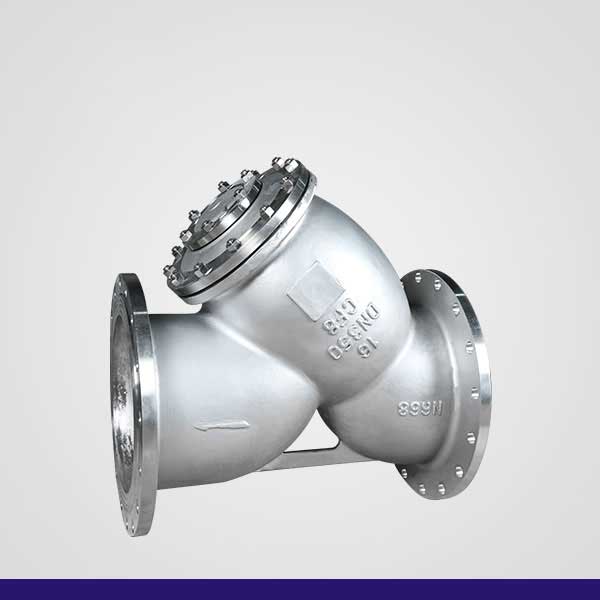
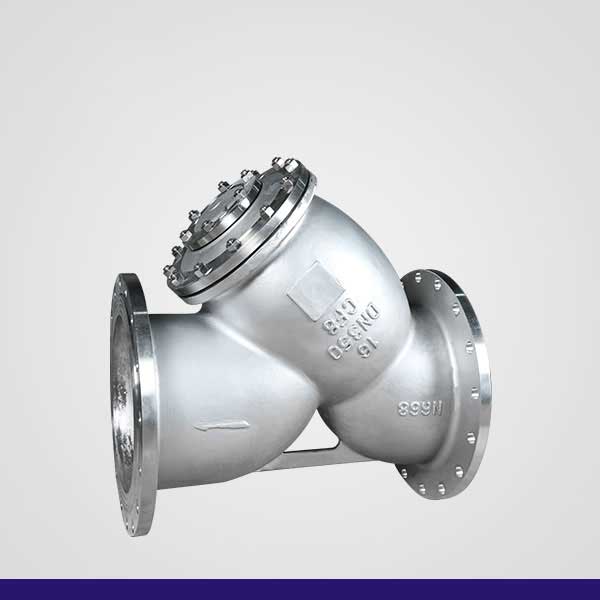
304 Stainless Steel Y-Strainer GL41W
This Y-type strainer operates as follows:
During normal operation, water enters through the inlet, flows through the filter screen, and exits to the pipeline for system circulation. Particle impurities are trapped inside the screen. As intercepted contaminants accumulate, filtration resistance increases and flow rate decreases, while incoming raw water continuously flows in, further blocking the screen and creating a pressure differential between inlet and outlet.
When the pressure difference reaches the preset value, the differential pressure transmitter sends a signal to the controller. The control system activates the drive motor, which rotates the transmission assembly to fully open the drain outlet and discharge filtered contaminants. After screen cleaning is completed, pressure drop falls to the minimum level, and the system returns to normal filtration operation.
This strainer consists of a body, multi-element filter cartridges, backwashing mechanism and differential pressure controller. A transverse partition divides the inner cavity into upper and lower chambers to maximize filtration area and reduce equipment size. A backwash suction disc is installed in the lower chamber.
During working state, turbid liquid flows into the lower chamber, then passes through the partition into the inner cavity of the filter element. Impurities larger than filter gaps are intercepted on the inner wall of the filter element, while purified liquid passes through gaps to the upper chamber and discharges from the outlet.
The strainer adopts high-strength wedge-shaped screen and realizes automatic cleaning via pressure difference and timing control. When internal impurity buildup reaches the set pressure value or preset cleaning interval, the system outputs an electric signal to actuate the backwashing mechanism. When the backwash suction disc aligns with the inlet side of the filter element, the drain valve opens to release system pressure. A negative pressure zone lower than external pipeline pressure forms at the suction disc, driving circulating water to reversely flush from outside to inside the filter element. Impurities attached to the inner wall are peeled off, flushed into the suction disc and discharged through the drain valve.
The entire process features uninterrupted material flow, low backwash water consumption, and fully automated operation. It is widely used in metallurgy, chemical engineering, petroleum, papermaking, pharmaceutical, mining, electric power and urban water supply sectors, for filtration of industrial circulating water, recycling water, emulsified liquid regeneration, waste oil treatment, continuous casting water systems in metallurgical plants, blast furnace water systems, and thermal power high-pressure demineralized water pipelines. It is an advanced, high-efficiency and easy-to-operate fully automatic filtering device.



Follow