Publish Time:2020-12
As 2019 passed its midpoint, most listed enterprises have released their half-year reports. Some companies achieved steady revenue growth, while others saw performance declines due to operational and strategic adjustments. In the valve industry, four major listed valve enterprises have also recently published their interim results.
As a core foundational segment of the machinery and equipment manufacturing sector, the valve industry plays a vital role in national economic development. Its applications span large-scale clean energy power generation, supercritical thermal power, gas-steam combined cycle systems, and large marine vessels. Especially in the rapidly expanding nuclear power field, valves range from simple shut-off types to highly sophisticated automatic control system components, boasting an extremely wide variety of specifications and designs.
After years of development, China’s valve industry has built a solid industrial scale, with remarkable progress made in product categories and technical R&D capabilities.
In the first half of 2019, four nuclear power units (Zhangzhou 1&2, Huizhou 1&2) officially passed safety review, and the National Nuclear Safety Administration issued operating licenses for Phase 1&2 of TaiShan Nuclear Power Plant, signaling a promising recovery for the domestic nuclear power sector. Meanwhile, the equipment manufacturing industry is accelerating transformation and upgrading, industrial automation continues to advance, and investment in sectors including oil & gas, petrochemicals, environmental protection, electric power and metallurgy maintains sustained growth — all these factors are driving the rapid development of the valve industry, bringing both challenges and opportunities for domestic valve enterprises.
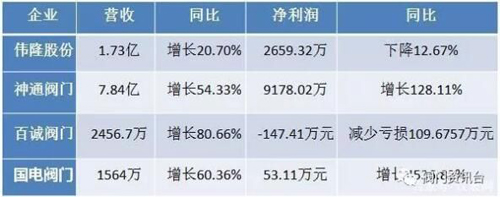
Judging from the interim performance reports of four listed valve companies, all achieved rapid business growth:
1. WF Valve: H1 operating revenue up 20.70% YoY. Its products are mainly export-oriented, with overseas sales accounting for 86.73% of main business revenue in H1 2019, covering over 50 countries and regions across Europe, North America, Southeast Asia, Asia and Oceania. During the period, the company expanded international layout, optimized product structure, boosted production capacity, and maintained steady growth of its core main business.
2. Shentong Valve: H1 revenue increased 54.33% YoY. Domestic market demand surged, with robust orders for energy chemical valves, flange and forging products. Excluding pressure service business downturns in downstream sectors like municipal engineering and metallurgy, revenue from the nuclear power sector saw considerable growth.
3. Baicheng Valve: H1 revenue surged 80.66% YoY. Driven by large-scale expansion of its main body business, the company successfully delivered key projects for Fujian United Petrochemical, Quanzhou Sinopec, Shanghai Saike Petrochemical and Great Wall Energy & Chemical, with order volume rising month-on-month.
4. State Power Valve: H1 revenue grew 60.36% YoY. Amid industry fluctuations, the company leveraged its established sales channel advantages, developed direct sales and online channels, optimized product mix, reduced polluting product supply, and increased R&D investment in new energy projects such as large-diameter long-distance natural gas pipelines and LNG applications.
From the development of these four valve enterprises, product R&D, independent branding, market positioning and service level stand out as core keywords.
- Product strength defines enterprise ceiling. State Power Valve elevated its R&D capability, deepened product structural upgrading, introduced world-class production equipment and international advanced inspection & testing systems, and increased its share in the high-end market.
- Brand influence builds corporate market competitiveness. WF Valve continuously enhanced its brand influence in overseas markets during the period, while Shentong Valve was listed among the Top 50 Independent Innovation Brands in Jiangsu Province, 2018.
- Market demand acts as a core growth driver. In the context of supply-side structural reform, Shentong Valve delivered notable growth in metallurgy, energy storage and nuclear power sectors.
Moving forward, Shentong Valve will uphold its market positioning of consolidating state-owned enterprise markets, developing nuclear power business, expanding petrochemical sectors, and strengthening service capabilities, increase investment in new product development and technical upgrading, and further lift product added value and core competitiveness.
While expanding production and R&D capacity, transforming into service-oriented enterprises is also critically important. From April to early June, Baicheng Valve worked overtime to complete multiple maintenance and repair orders. Through the deep integration of products and services, it demonstrated outstanding maintenance capabilities, enhanced customer trust and brand reputation among valve buyers, and won widespread recognition and praise from clients.
Despite strong overall revenue growth, the half-year reports of the four listed companies also reveal deep-seated challenges within China’s valve industry. While three of the four enterprises maintained rapid growth, one recorded slowing profit growth. According to 2017 industry statistics, there were approximately 3,000 valve manufacturers nationwide. With a large number of competitors, rising labor costs and fierce market rivalry, the overall profit margin of the sector remains relatively low. Meanwhile, domestic technical standards in the valve field are generally lagging, leaving enterprises vulnerable to being eliminated by market shifts.
Currently, China’s valve manufacturing industry has grown in scale, yet the path to becoming a globally strong industrial player remains unfinished. Industrial transformation, upgrading and technological innovation are the only way for valve enterprises to grow bigger and stronger. Faced with intense market competition, valve manufacturers must promptly adjust their product structure, attach importance to independent brand building, elevate R&D capabilities and service standards, and integrate multi-party resources to achieve rapid corporate development.

Follow